
Don't miss the opportunity to tour some of the area's finest healthcare facilities.
Pre-registration for a facility tour is required. There is an additional fee for the facility tours and space is limited. Facility tours are available only to those who have registered for a Full Conference Pass (not available to exhibit hall only, guest/spouse, and one-day pass registrants). Pre-registering entitles you access ONLY to the specific facility tour you preselected. You will be required to wear your conference badge during the tour. Transportation will be provided.
T01— Middle Tennessee Medical Center
Sunday, November 13 | 1:00 p.m.—5 p.m.

The $267 million, 286-bed Middle Tennessee Medical Center (MTMC) opened in October 2010. Several unique and innovative designs were incorporated into the new 556,000-square-foot facility, offering the latest in patient-centered care. From patient rooms and family waiting areas to safety measures and navigation, the new MTMC provides superior care in an environment to match.
During the design phase of the new MTMC, hospital leadership and the design firm of Gresham, Smith and Partners, incorporated the latest research and studies on patient safety and wayfinding into the hospital's design. For example, all patient rooms in the new facility are "same-handed," meaning they are identical rather than traditionally mirrored rooms. Wayfinding was also designed to minimize confusion and allow patients, visitors, and associates to navigate the hospital as quickly and sensibly as possible.
Spacious patient rooms in the new facility provide family zones, offering comfort for family and visitors who are staying with their loved one. This allows families to hear directions from caregivers and be well informed about the care process once their loved one returns home. Each room has a large window for maximum natural light, which has been shown to facilitate the healing process. All rooms are private and have a handicap-accessible bathroom.
| Sponsored by: | ![]() |
T02 — Vanderbilt Health—One Hundred Oaks (OHO) Outpatient Clinic Mall
Sunday, November 13 | 1:00 p.m. — 5 p.m.

Vanderbilt University Medical Center has dramatically increased outpatient volumes over the last two decades. Building new space on the historic campus has become overly expensive due to very tight site logistics and the need for structured and underground parking. Although successful, clinics in distributed sites lack the efficiencies and collaboration available in a consolidated facility, and do not capture the "branding" opportunities that a highly visible, large scale site commands.
One Hundred Oaks Mall was opened in 1967 as Nashville's premier shopping destination. Over the years, it declined and was ultimately listed on the "Dead Malls.com" web site. The lower level stores that opened directly onto the parking lot were doing relatively well, but the 370,000-square-foot upper-level mall was virtually abandoned.
In 2007, Vanderbilt started discussions with the mall's new owners about transforming the site and building into a highly attractive destination for retail, medical, entertainment, and dining.
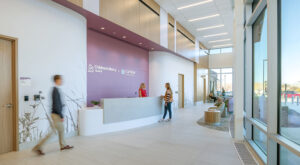
After two years of exterior and interior renovation, Vanderbilt opened more than 350,000 square feet of clinics and 60,000 square feet of office space. The 22 clinics, pharmacy, imaging, and lab create a consolidated campus with unprecedented convenience for patients. A LEED-certified facility, design by Gresham, Smith and Partners, has been highly successful and is now a model for other owners and medical centers across the nation.
Photographer: Michael Lewis
T03 — Monroe Carell Jr. Children's Hospital at Vanderbilt
Sunday, November 13 | 1:00 p.m. — 5 p.m.

The 206-bed, eight-story Monroe Carell Jr. Children's Hospital at Vanderbilt was designed "from the inside out," with the exterior reflecting the character of the interior. A whimsical approach softens the highly technical capabilities to treat even the sickest children.
The curving glass and granite 616,785-square-foot hospital was completed in 2004 to replace the former children's "hospital within a hospital" at Vanderbilt University Medical Center. Art is infused into the architecture from the exterior and throughout the interior spaces. Colorful elements support the Tennessee nature theme with friendly bugs, amphibians, and animals marching across floors and nurses' stations. Curving metal ceiling treatment in the "main street" area on the second floor abstractly represents the theme "ribbons of hope and rivers of healing."
Crayon-like tubes house family areas, cones disguise mechanical elements, and a ribbon-like canopy introduces the entrance. The design architects, Earl Swensson & Associates, introduced family sleep areas, quiet areas, kitchens, and a business center to accommodate family centered care. An 11-story, 171, 257-square-foot Doctors' Office Tower is attached.
| Sponsored by: | ![]() |
T04 — Combined Tour: Vanderbilt-Ingram Cancer Center and Vanderbilt Hospital Critical Care Tower, Vanderbilt Medical Center
Sunday, November 13 | 1:00 p.m. — 5 p.m.

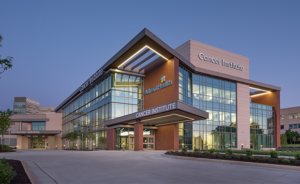
The Henry-Joyce Cancer Clinic, the hub of the Vanderbilt Ingram Cancer Center, is located in the heart of the Vanderbilt University Medical Center. In 2006, the medical center began planning a series of renovation projects designed to more than double its capacity to deliver state-of-the-art care to cancer patients in the region. The expansion was necessary to not only accommodate more patients, but provide better access and to create an enhanced patient-friendly atmosphere.
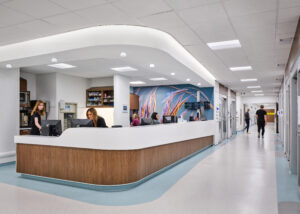
Architects with Southeast Venture were hired to design a new 8,000-square-foot central registration area and lab, a 22,000-square-foot out-patient clinic, and an 18,000-square-foot infusion suite. The out-patient clinic includes 36 exam and treatment rooms, team work areas, and a large waiting area with a patient and family resource center. The 45-bay infusion suite was designed with three pods of 15 bays surrounding a central chemo pharmacy. Each pod has a nurse's station, team work area, and dedicated support space. In both clinic and waiting areas, lighting, interior finishes, and artwork were selected to reflect a calm and soothing environment for patients and families.
These expanded areas are just a portion of the Vanderbilt Ingram Cancer Center, which bring together the clinical oncology programs with research, education, and outreach activities of Vanderbilt University Medical Center.
The Critical Care Tower

The Critical Care Tower is a nine-story addition to the Vanderbilt University Hospital that was completed in November 2009. The 329,000-square-foot building was designed by Donald Blair Architects with Earl Swenson Associates as architect of record. The new tower includes five floors of acute care beds, 12 new state-of-the-art operating rooms, and space for future expansion of procedural areas, patient observation, and waiting.
Since the hospital opened in 1980, the amount of space needed to care for critically ill patients has changed significantly to support equipment, staffing, and changing technologies. The patient rooms, at 320 square foot each, were designed with larger patient and staff areas and with patient and family centered care in mind. Three bariatric and six isolation rooms are included on each floor, and every room is equipped with a dialysis hook up.
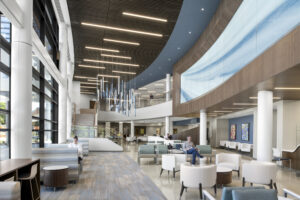
Other features of the Critical Care Tower include a light-filled atrium, improved visitor waiting areas, increased staff support space, and eight new visitor and patient elevators. The opening of the tower also allowed for expansion of existing services such as PACU, Blood Bank, and Surgical Pathology within the existing hospital.
| Sponsored by: | ![]() |
T05 - Combined Tour: Vanderbilt-Eskind Biomedical Library and Medical Research Building IV, Vanderbilt Medical Center
Sunday, November 13 | 1:00 p.m. — 5 p.m.

Before the Eskind Biomedical Library opened, the medical library had been tucked away in the most distant corner of the original 1925 hospital building. Annette and Irwin Eskind envisioned a library at the hinge-pin of the medical campus, easily accessible to medical students, patient families, faculty, and staff. A site was created on what was once a roadway and the finished building has become one of the most beloved and admired buildings on the Vanderbilt campus. In addition to reference, circulation, study/research, and stack spaces, the library houses the medical center's special collections and board rooms.
The 78,000-square-foot, five-story building was designed by Davis Brody Bond with Thomas Miller and Partners as architects of record. It has earned a Tennessee AIA Honor Award, a Gulf States AIA Region Honor Award, and a New York State AIA Excellence in Design Award. The 55- foot-high, north-facing curved glass wall opens the space to light and views.
The design and organization of the building separates public research and study spaces from staff and stack spaces. A unique plan incorporates journals, books, and electronic access to a rapidly growing body of knowledge—all spaces designed to accommodate either stacks or computer workstations. The design was one of the first in America to plan the library not only as a repository of knowledge, but in anticipation that computers and the Internet would provide access to knowledge from the dorm room, home, office, patient floor or anywhere the user had access to the Internet. The library has become a place where users go to consult with information experts who help them locate, interpret, and organize information to be shared throughout the university and world.
Davis Brody Bond Aedas, along with Donald Blair Architects, was commissioned to design Vanderbilt University Medical Center's fourth major medical research facility, known as Medical Research Building IV. The new facility was built over two existing occupied buildings. Phase I consists of a four-story vertical expansion of an existing Education/Laboratory building constructed in 1978. The phase I new addition was completed in fall 2005. Phase II consists of a research tower that spans over an existing 1,200-seat auditorium building. Occupancy of Phase II began in fall 2007. Both of the existing buildings remained in use during the construction of Medical Research Building IV.
This solution provides 400,000-gross-square-feet of new, state-of-the-art biomedical research laboratories without the need to expand the Medical Center's campus, and without any major impact to the campus' site plan and functional layout. Other benefits include optimal adjacencies for various interdisciplinary research programs, improved MEP infrastructure, and improved planning and overall building efficiencies for all three buildings.
T06 - Williamson Medical Center
Sunday, November 13 | 1:00 p.m. — 5 p.m.

Substantial renovation and expansion of Williamson Medical Center, designed by Earl Swensson Associates, Inc. and completed in late 2007, transformed the community hospital, with a total of 185 beds, into a visibly positioned competitor in the regional market. This complex project encompassed three sides of the facility, on top of the existing facility and internally (in every clinical department except surgery and recovery), all while the hospital remained in operation.
The 1986 four-story hospital, which had a high mix of semi-private rooms, experienced this image makeover with renovations of 116,000 square feet and an expansion of 94,000 square feet, bringing the facility to six stories. A new, integrated 170,000-square-foot, seven-story medical office building, connected to the hospital at all floors, is anchored with an outpatient surgery department.
Close partnering with the contractor allowed sequential phasing for minimal disruption of existing operations. The Medical Center was also willing to aggressively relocate several departments to streamline the process. One example is that administration, medical records, and physical therapy were relocated to modular buildings to allow existing space to be renovated for the first phase of the emergency department. The facility now has a new main entry, a new emergency department, two new patient floors, and new spaces for imaging, central registration, food service, lab, obstetrics, physical therapy, and various other support services. All patient rooms are now private.
| Sponsored by: | ![]() |
T07 - Aegis Sciences Corporation Forensics Laboratory—Renovation of 515 Great Circle Road
Sunday, November 13 | 1:00 p.m. — 5 p.m.

Founded as a sports doping laboratory in 1986, Aegis Sciences Corporation has evolved into a full-service forensic sciences company providing toxicology and consulting services to sports organizations, medical examiner systems, crime laboratories, physicians, corporations, and other organizations throughout the U.S. and the world. Because of an expanding client base, the forensic chemical and drug-testing laboratory corporation needed to expand its facility. An existing 35,000-square-foot 1991 pre-engineered office/warehouse was purchased for renovation and adaptive re-use.
For better efficiency and utilization of lab personnel, HFR Design planned a facility with the various lab functions combined into a 15,000-square-foot open lab with mobile, modular lab tables and cabinets, plus 4,000 square feet of lab support space. The remaining 16,000 square feet of office area was renovated/refurbished to meet the administrative, support, and security needs of Aegis Sciences Corporation. The newly renovated laboratory was fully occupied and operational in June 2008.
T08 - Heritage Medical Center
Sunday, November 13 | 1:00 p.m. — 5 p.m.

The new Heritage Medical Center located in rural Bedford County, Tennessee, is a stark contradiction to its outdated predecessor. The 60-bed, 99,000-square-foot modern community hospital replaced a 1950s facility with a contemporary state-of-the-art medical facility that meets today's standards in providing the highest level of patient care. Designed by Thomas, Miller & Partners, PLLC, this project is an excellent case study illustrating the positive changes that can occur when a large for-profit healthcare company acquires a small community-based facility lacking access to capital and resources.
Simple, straightforward circulation was the driving force behind the design, and every decision was based upon creating highly efficient, easily navigable traffic patterns and clear separations between patient, public, and staff areas. The main organizing element is the north-south circulation spine, which begins at one end with the hectic, 24-hour pace of the emergency department, passes through the main lobby, and ends with the hospital's cafeteria—a place of respite, providing endless views of the surrounding countryside. All public points are located off of this central spine, which offers ceiling heights reaching 16 feet and continuous clerestory windows to access optimal natural light.
One of the most dramatic contrasts between the previous hospital and the new replacement facility is this abundance of natural light. A patient, visitor, or staff member feels a continual connectivity to the outside. Internal nurse stations are connected to the outside environment through careful design, sharing the expansive views and natural light from adjacent waiting areas. The majority of staff lounges are carefully located on exterior walls, windows are strategically placed at the ends of common corridors, and the oversized patient room windows offer plenty of natural light, an element that has proven to be a crucial aspect of the healing process.
Photography: Creative Sources Photography & Architectural Image Group
T09: Department of Veterans Affairs Tennessee Valley Healthcare System (VA TVHS)
Sunday, November 13 | 1:00 p.m. — 5 p.m.

This Phase I ACRE Research Laboratory project is a complete renovation of the existing 13,536 SF 5th floor. The original layout had a central corridor with several small laboratories and offices on each side. The new layout is an open lab concept utilizing modular casework on the west side and concentrating the offices, fume hood alcoves and equipment rooms on the east side. By removing walls lab bench space was maximized.
The project also includes 2 tissue cultures, cold room, microscope room, break room and ample storage spaces. In addition to the equipment rooms the researchers can utilize the adjustable mobile instrument tables and ample floor space for a wide array of research instruments in the Instrument Room. A tank cylinder storage room is located adjacent to the existing elevators for convenience of delivery and pick up without having to enter the laboratory area.
The east and west exterior walls of the building have an existing curtain wall spandrel and glass window system. From the interior the existing window openings offered limited visibility and light with the rest of the curtain wall covered by gypsum wall board. To enhance the open lab design concept the existing glass and spandrel panels were removed from the existing frames and replaced with low-E, argon filled insulated glass panels. This allowed a ribbon of day-light to fill the work spaces on each side of the building. Automatic roller window shades track the path of the sun and raise and lower throughout the day.
This tour is limited to 25 attendees.